
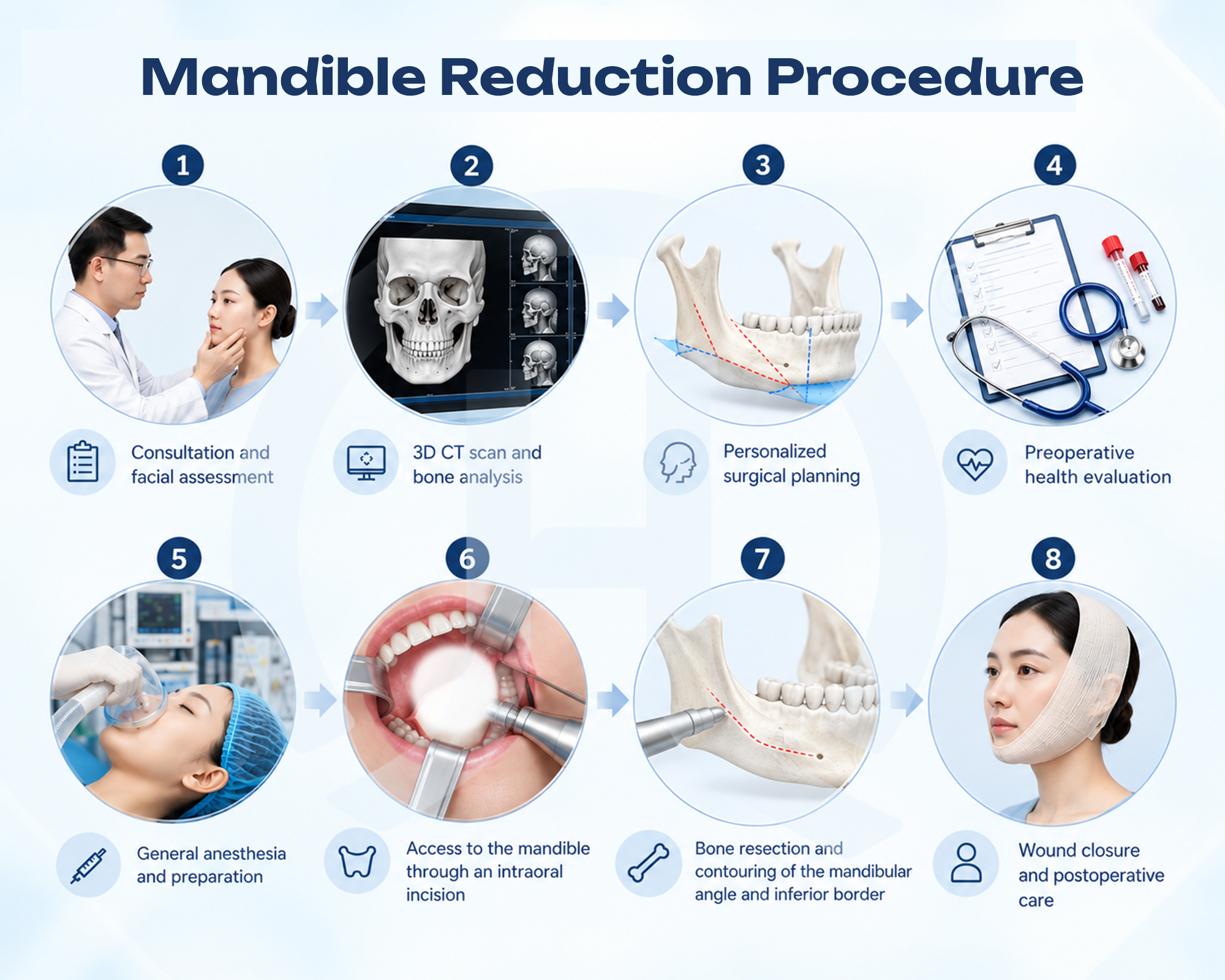
The mandible reduction procedure consists of eight steps: consultation and facial assessment, 3D Cone Beam CT imaging, surgical planning, preoperative health assessment, general anesthesia, intraoral access to the mandible, contouring of the mandibular angle and inferior border, followed by wound closure and postoperative monitoring.
At Dr Huan, the mandible reduction procedure is planned according to each patient’s bone structure and facial characteristics. The extent of bone contouring is determined individually, with the goal of improving the lower facial contour while maintaining overall facial harmony.

The 8-step mandible reduction procedure at Dr Huan
Mandible reduction does not begin by deciding how much bone should be removed. The first step is to identify the structures contributing to a wide or square lower face. Based on the clinical examination and 3D CT images, the surgeon then develops an appropriate surgical plan.
Step 1: Consultation and facial assessment
Dr. Nguyen Duy Huan directly evaluates the mandibular angle, inferior border of the mandible, lower facial width, masseter muscles, soft tissues, chin, and facial symmetry.
This assessment helps determine whether a wide or square lower face is primarily caused by the underlying bone or whether the muscles and soft tissues also contribute to its appearance. Based on these findings, the surgeon can determine an appropriate treatment approach.
Step 2: 3D Cone Beam CT and mandibular analysis
A 3D Cone Beam CT scan is performed to assess the shape of the mandible, the degree of asymmetry, and relevant anatomical structures.
Combined with the clinical examination, the CT data helps the surgeon identify which areas of bone need to be adjusted and determine the appropriate extent of surgery for each patient.
Step 3: Personalized mandible reduction planning
Based on the patient’s bone structure and facial proportions, the surgeon determines the location, extent, and planned contour of bone adjustment.
Some patients may require greater correction at the mandibular angle, while others may also need contouring along the inferior border to create a smoother transition. Therefore, the surgical plan is individualized rather than applying the same jawline shape to every patient.
Step 4: Preoperative health assessment
Before surgery, the patient undergoes the necessary examinations and tests to assess overall health and suitability for general anesthesia.
Medical history, current medications, and other relevant health factors are also reviewed before proceeding with surgery.
Step 5: General anesthesia and surgical preparation
Mandible reduction is performed under general anesthesia. The patient is prepared according to the surgical protocol and monitored by the anesthesia team throughout the procedure.
Step 6: Intraoral access to the mandible
The surgeon makes an incision inside the mouth to access the areas of the mandible that require adjustment.
This intraoral approach provides access to the mandibular angle and inferior border without creating a direct surgical incision on the external skin of the jawline.
Step 7: Contouring the mandibular angle and inferior border
This is the main surgical step of the mandible reduction procedure. Based on the preoperative plan, the surgeon adjusts the necessary portions of the mandibular angle and inferior border to create a smooth and balanced transition.
At Dr Huan, the Piezotome ultrasonic bone surgery system may be used to support controlled bone cutting during surgery. After contouring, the surgeon reassesses the bony outline and symmetry between both sides before completing the procedure.
Step 8: Wound closure and postoperative monitoring
After the surgical area has been checked, the intraoral incision is closed. The patient is then monitored after surgery and receives instructions regarding compression, oral hygiene, diet, medications, and follow-up appointments.
Facial swelling is common during the first few days and gradually decreases during recovery. The degree of swelling and the time required for the face to stabilize can vary from person to person.
How long does the mandible reduction procedure take?
The duration of surgery depends on the patient’s bone structure, the extent of contouring required, and whether mandible reduction is combined with other procedures.
The surgery itself typically takes approximately 45–60 minutes.
In addition to operating time, the overall procedure includes consultation, 3D CT imaging, preoperative health assessment, anesthesia preparation, and postoperative monitoring. The specific timeline is discussed after an individualized surgical plan has been established.
How long does it take for the face to stabilize after mandible reduction?
Facial swelling is usually more noticeable during the early postoperative period and gradually decreases over time. As the soft tissues adapt to the new underlying bone structure, the jawline becomes progressively more defined.
Recovery time varies depending on the extent of surgery, individual healing characteristics, and postoperative care. Therefore, the result should be evaluated after swelling has subsided and the soft tissues have had sufficient time to stabilize.
Why should mandible reduction be performed at a properly equipped surgical facility?
Mandible reduction involves direct surgery on the lower jawbone, is performed under general anesthesia, and requires postoperative monitoring. The facility must therefore meet the necessary professional, anesthesia, and resuscitation requirements and be authorized to perform the relevant surgical procedures in accordance with Vietnamese Ministry of Health regulations.
Performing the procedure at an appropriately equipped facility allows preoperative health assessment, anesthesia, surgery, and postoperative monitoring to be carried out within a comprehensive medical protocol.
At Dr Huan, mandible reduction surgery is performed at Bac Ha International General Hospital (137 Nguyen Van Cu Street, Hanoi, Vietnam).

Frequently asked questions about the mandible reduction procedure
Is general anesthesia used for mandible reduction?
Yes. Mandible reduction is a facial bone surgery performed under general anesthesia. Before surgery, patients undergo health screening and pre-anesthetic assessment according to the required protocol.
Is mandible reduction painful?
The procedure is performed under general anesthesia. After surgery, patients may experience swelling, tightness, or discomfort to varying degrees. Medication and postoperative care instructions are provided during the recovery period.
Does the mandible reduction procedure require a 3D CT scan?
A 3D CT scan helps assess the shape of the mandible, the degree of asymmetry, and relevant anatomical structures. This information helps the surgeon identify the areas of bone that require adjustment and develop an individualized surgical plan.
Does mandible reduction leave visible scars?
Mandible reduction is typically performed through an incision inside the mouth, so there is no direct surgical incision on the external skin around the mandibular angle.
The mandible reduction procedure consists of eight steps, from consultation, 3D CT imaging, and surgical planning to anesthesia, bone contouring, and postoperative monitoring. Identifying the structures contributing to a wide lower face and determining the appropriate extent of bone adjustment are important for developing an individualized surgical plan.
Patients considering mandible reduction can have a consultation with Dr. Nguyen Duy Huan for a facial assessment, 3D Cone Beam CT analysis, and a surgical plan based on their individual anatomy and needs.
WhatsApp +84 916 262 888 / +84 986 258 118
